

Events
Upcoming Events
Two instalments of the CPLJ Lecture Series – funded by the FNR as well (FNR - RESCOM/2022/LE/17576191) - are planned for the coming months, namely:
17/05: ‘Advancing community dispute prevention in multilateral infrastructure development’ by Prof. Shahla Ali (University of Hong Kong)
12/06: ‘The introduction and new patterns of precedent systems in the procedural law of the traditional civil law countries: possibilities and innovations for the stare decisis’ by Aluisio Gonçalves de Castro Mendes (Rio de Janeiro State University – UERJ)
Register here.
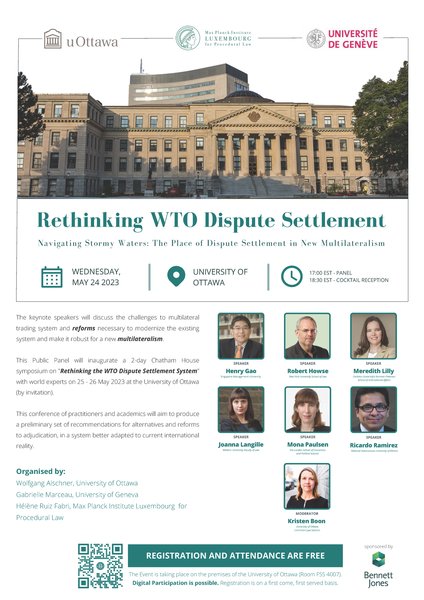
On 24-26 May, International Workshop ‘Rethinking WTO Dispute Settlement’ (Ottawa)
Dispute settlement at the World Trade Organization (WTO) is in crisis. The Appellate Body (AB), the WTO’s highest adjudicatory body, has been defunct since 2019 because the United States has vetoed the appointment of new members. Its absence has also undermined the first instance panels whose reports can be appealed into the void. As a result, WTO dispute settlement no longer functions as intended. Yet, in 2022 WTO Members committed themselves to re-establishing a ‘fully and well-functioning dispute settlement system’ that is ‘accessible to all Members’ by 2024. The race is now on to rethink WTO dispute settlement.
This conference will convene leading experts from around the globe at the University of Ottawa to discuss new approaches to revitalize the WTO dispute settlement system. Co-organized by Professors Wolfgang Alschner (University of Ottawa), Hélène Ruiz Fabri, and Gabrielle Marceau (University of Geneva), the gathering seeks to support WTO Members’ ambitious target to achieve a dispute settlement reform in the next two years.
The closed selective workshop (25-26/05) will be preceded by a hybrid public panel discussion on May 24. (Registration for public panel).
On 6-7 July, International Conference ‘Human Rights and Procedures: Perspectives of International Law’
Organised in collaboration with the University of Strasbourg, the conference designed by Dr Olivier Baillet and Prof. Hélène Ruiz Fabri aims to provide a theoretical, critical and transversal reflection on the relationship between human rights and procedure. The analysis will focus on two pivotal issues: the procedural mechanisms of human rights protection that exist in international law on the one hand and the place of procedure in the content of international human rights law on the other.
Past Events
On 27 February, the fifth edition of the Forum on Procedural Law of the Court of Justice of the European Union (CJEU) took place at the MPI premises. The event was co-organised by Prof. Daniel Sarmiento Ramírez-Escudero (Complutense University of Madrid), Prof. Hélène Ruiz Fabri and Prof. Burkhard Hess.
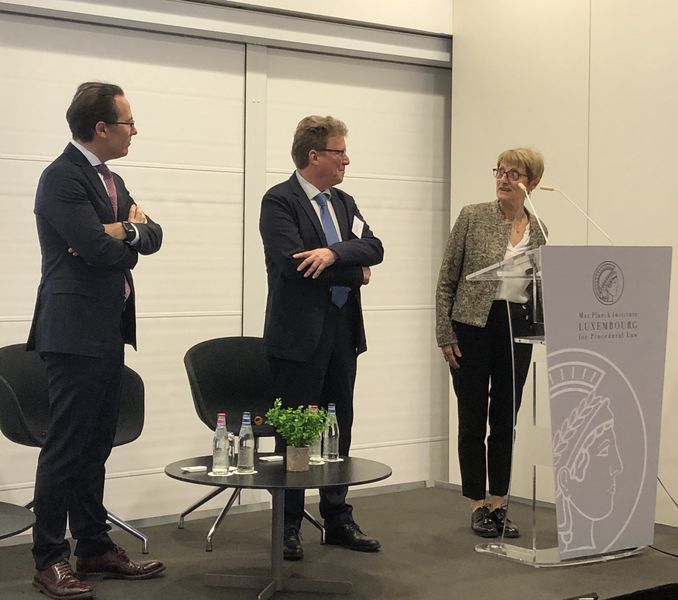
The purpose of this annual meeting of specialists in EU law and procedural lawis twofold. First, the EU forum intends to tackle cutting-edge procedural issues which arise in the Court's proceedings and case-law. Second, it aims at providing an update on procedural issues. Ultimately, it is intended to facilitate comparison with other jurisdictions, both national and international.
The 2023 edition gave the floor to Prof. Takis Tridimas (King’s College London), Ass. Prof. Lena Hornkohl (Vienna University), Prof. Burkhard Hess, Prof. Enrique Vallines, Prof. Sara Iglesias (Complutense University of Madrid), Carsten Zatschler (Barrister. Senior Counsel, Dublin & Brussels), Ass. Prof. Marta Simoncini (LUISS Guido Carli University), and Dr Janek Nowak (Vrije Universiteit Brussels).
On 23-24 March, the participants in the Department of European and Comparative Procedural Law hosted the mid-term conference of the Comparative Procedural Law and Justice (CPLJ) project. In this context, the CPLJ researchers presented their progress to date, as well as outlooks for the future of the project.
Several DECPL Fellows participating to the project presented their preliminary results:
 |
- ‘Segment 4: Access to Justice and Costs of Litigation’: Dr Ramon Feldbrin and Anastasia Trubacheva
- ‘Segment 7: Structure of Civil Litigation’: Prof. Enrique Vallines (General Editor of the CPLJ project)
- ‘Segment 9: Final Judgment, Appeals and Review’: Hannah Deters
- ‘Segment 12: Special Forms of Procedures’: Walter Bruno
- ‘Segment 15: Cross-Border and International Dimensions’: Prof. Burkhard Hess General Editor of the CPLJ project)
- ‘Segment 17: Arbitration’: Dr Serhii Kravtsov
Funded by the FNR (O19/13946847), the CPLJ project has, to date, permitted more than 100 renowned scholars and researchers from around the world to develop collaborative approaches to the study of civil procedural law and civil dispute resolution.
In the framework of the CPLJ lecture series complementing the CPLJ project, outstanding scholars with complementary expertise address comparative procedural law from a global multidisciplinary perspective. For example, on 27 March, Prof. Nadja Alexander (Singapore Management University) presented on ‘Comparative Mediation Law in the EU: an Analysis of Developments in Mediation Law Applicable to Cross-Border Commercial Disputes in Light of the UN Convention on International Settlement Agreements Resulting from Mediation’.
On 12 April, Book Launch ‘The International Legal Order in Global Governance: Norms, Power and Policy’ by Dr Alain Germeaux (Ministry of Foreign Affairs, Luxembourg), with Prof. Edoardo Stoppioni (University of Strasbourg) as discussant.
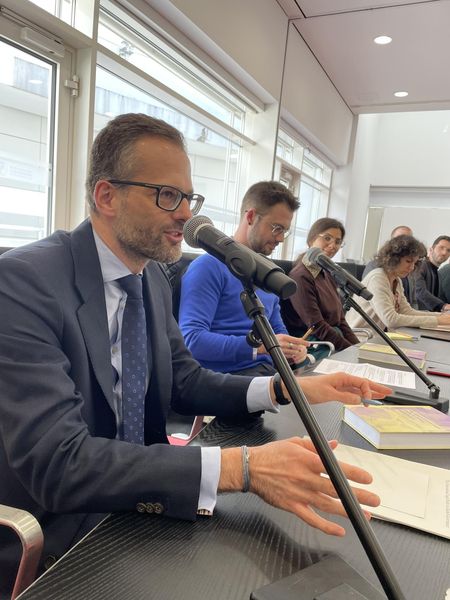
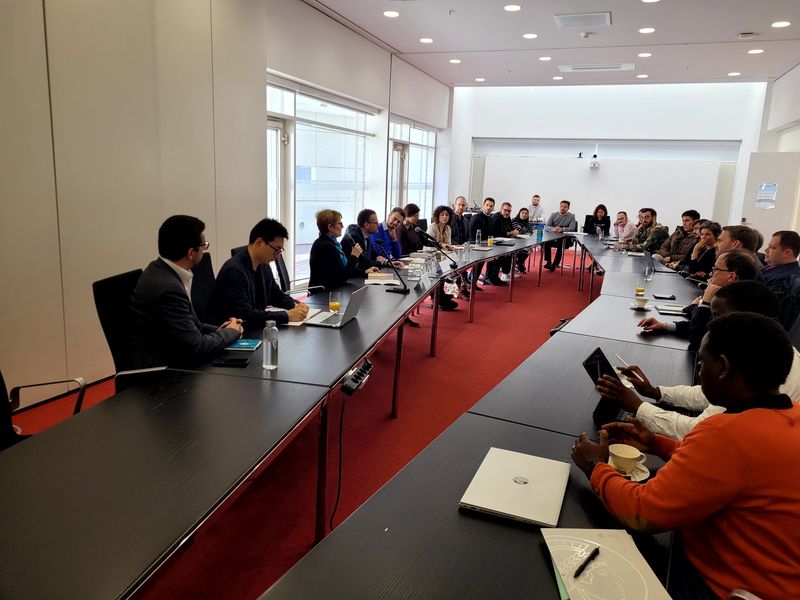
In The International Legal Order in Global Governance: Norms, Power and Policy (Palgrave Macmillan, 2022), Dr Germeaux advances an analytical framework for understanding the effect of norms on behaviour while being informed by the practical realities and practice of international organisation in examining the challenges the international legal order faces and what the way forward may look like. It draws on international law, political theory, cognitive psychology and behavioural economics to explore a communicative-action based approach of how norms and ideas persuade actors to engage in a course of action consonant with international law to achieve a particular outcome.