

Library Highlights
KEEP DISCOVERING OUR RESOURCES!
Emojis have become part of our today’s life and have developed into serious indicators in communication. These pictograms can no longer be ignored. A picture sometimes says more than 1000 words. Meant to share love or hatred, to encourage the other or to insult, to show disagreement or approval
The ‘thumbs-up gesture’, according to “emojipedia” (yes it exists!), indicates approval (“a popular means of quickly and earnestly expressing approval”). And this symbol is an emoji shared hundreds of millions times each day. The “Thumbs Up” has become so common that it was approved as part of Unicode 6.0 in 2010 under the name ’Thumbs Up Sign’.
Most interestingly – since law reflects or should mirror developments in society – the has become a central issue in a litigation, in Canada. A judge of this country has ruled that in some cases it might be valid as a signature, signalling it were high time that the judiciary adapts to the 'new reality' of communication with each other.
As the Guardian reports, a company that wanted to buy flax texted a contract to a farmer and wrote: "Please confirm the flax contract." The farmer responded with. But when the agreed date had passed, the farmer had not delivered anything.
Read the full article here: bit.ly/3Kh2tDc
In court, the buyer argued that he assumed that meant that the farmer had agreed to the agreement. The farmer said that he only wanted to indicate with the thumb that he had received the contract. “[W]ould [this, eventually,] open up the flood gates” to new interpretations of other emojis, including the ‘fist bump’ and ‘hand shake’.
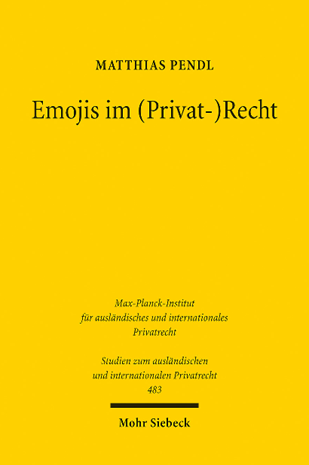
In this sense Matthias Pendl’s book “Emojis im (Privat-)Recht” (‘Studien zum ausländischen und internationalen Privatrecht, 483’, Mohr Siebeck, Tübingen 2022, XV + 124 S.), published as Open Access/Online Publication, but also available in our Max Planck Luxembourg Library (DE 96 Pen 2022), seems to be a highly timely book.
The author, dr Matthew Pendl, is at the Max Planck Institute for Comparative and International Private Law in Hamburg, and his research focus is on civil law, commercial and corporate law, banking and capital market law, law and digitization, comparative law; he defended a thesis on claims for damages against board members and auditors.
The omnipresence of emojis is (in Pendl’s words ) evidenced by the impressive number of judgments from Germany and abroad and from a wide variety of legal areas, which has been steadily growing in recent years. Criminal, labor and trademark law are also areas of emoji case law, as are the law of obligations, family law and freedom of speech.
Our Library looks forward the impact of this new feature and the new legal future